Female Engineer Apparel: A Practical Buying Guide for 2026
What if the best female engineer apparel isn’t the piece labeled “for women,” but the one that suits your work, taste, and measurements? Engineering-themed clothing can miss the mark when it leans on stale stereotypes or gives little detail about its cut and materials. A job title on a shirt isn’t enough; the design should feel like you.
You should be able to compare women’s engineering T-shirts with broader engineering tees, hoodies, and organic apparel without guessing what “comfortable” or “sustainable” means. Check garment measurements and size guidance, look for clearly stated fabric composition, and decide whether the graphic suits your style.
This guide covers practical checks for fit, design, garment type, and material claims. You’ll learn what to look for across T-shirts, hoodies, and organic options, and how engineering experience can inform relevant designs without implying anything about garment performance.
Key Takeaways
- Choose female engineer apparel by the details that matter to your day, not by gendered labels alone.
- Match the garment type to how you plan to wear it, including whether you’ll layer it and how visible you want the design to be.
- Use a garment you already own as a reference when checking size charts and product measurements.
- Read material and care information before treating an organic claim as a meaningful specification.
- Separate must-haves from style preferences to compare options without getting distracted by marketing.
What Makes Female Engineer Apparel Worth Choosing?
Female engineer apparel is engineering-themed everyday clothing chosen by women engineers for its design, comfort, and personal relevance, not a fixed dress code or silhouette. It might be a T-shirt with a technical joke, a hoodie with an engineering graphic, or another garment that reflects how someone sees her work and interests. The connection matters more than any prescribed look.
That distinction matters in a field where women remain under-represented in the academic and professional fields of engineering. Apparel can express professional identity or help someone feel recognized, but no single design represents every engineer. A clever circuit reference may suit one person; another may prefer a subtle graphic or no work-related design. Relevance, comfort, and personal taste are more useful guides than assumptions built into gendered marketing.
Engineering-themed apparel is also different from a uniform, employer-issued clothing, or protective workwear. It’s everyday clothing chosen for expression, not a garment specified for a particular employer or task. Expressive engineering apparel communicates identity; task-specific protective equipment is selected for workplace hazards and must meet the requirements of the job. A graphic tee or hoodie doesn’t replace required protective equipment.
Who Is Engineering Apparel For?
Practicing engineers, engineering students, designers, builders, and people shopping for them may all look for engineering-themed clothing. Their preferences won’t necessarily align. Someone might want a bold slogan for casual wear, while a gift buyer may look for a design tied to a specific discipline or a shared technical joke. These are useful starting points, not rules about what women engineers should wear.
Think about the person and setting. Is the garment for campus, a casual office, time outside work, or a gift? Whatever the setting, everyday apparel isn’t a substitute for protective equipment required on a job site or in a lab. Check workplace guidance for task-specific clothing and equipment.
What Does “Designed for Women” Actually Tell You?
A women-focused category tells you how a retailer organizes or targets a product. By itself, it doesn’t confirm the garment’s cut, measurements, or fit. Use the label to narrow your search, then check the size chart, garment measurements, and fit guidance. Comparing those details with a garment you already like gives you a more useful point of reference.
Choose the fit that feels right to you. You might prefer a relaxed shape, a closer fit, or a standard unisex option. None is more authentic than another. Treat “designed for women” as a prompt to inspect the specifications, not a promise that the garment will fit every body or match every preference.
Compare Female Engineer T-Shirts, Hoodies, and Organic Apparel
These categories answer different shopping questions. A T-shirt or hoodie describes a garment; organic apparel describes a material claim or product category. They aren’t three mutually exclusive garment types. An organic item, for example, still needs to be assessed by its design and product details.
| Category | Intended use | Layering preference | Design visibility | Product information to check |
|---|---|---|---|---|
| Engineering T-shirt | Everyday wear or warmer settings | Often worn alone; can also be layered | Graphic is usually easy to see when worn as the outer layer | Measurements, fabric composition, care instructions, and design placement |
| Engineering hoodie | Casual settings and an additional clothing layer | Works over a base layer, depending on the garment and outfit | Check how the graphic appears when worn open or closed, if applicable | Measurements, material details, care instructions, and garment construction |
| Organic apparel | For shoppers prioritizing a stated material claim | Depends on whether the item is a T-shirt, hoodie, or another garment | Depends on the garment and its design | Exact fiber composition and any stated certification or supporting detail |
When Does an Engineering T-Shirt Make Sense?
A T-shirt can suit everyday wear, warmer conditions, or situations where you want its engineering graphic to be visible. Compare the listed garment measurements with a T-shirt you already find comfortable. Check the stated fabric composition and care instructions too; neither can be reliably inferred from the product photo or category label. For more context on design and specifications, see the engineer T-shirt uniform guide.
When Should You Choose a Hoodie or Organic Apparel?
A hoodie is a layering option, but its warmth, weight, and performance depend on its stated specifications. Review the engineering hoodie technical guide for more points to consider. Penn State’s guidance on professional attire for engineers can also help you think through the setting and dress expectations.
For organic apparel, check the specific product page for fiber composition and any certification details. The category name alone doesn’t verify what a garment contains. Choose based on how you’ll wear it, what your wardrobe needs, and which material priorities matter to you. To compare engineering-focused options, browse grabNade’s engineering apparel categories and review each item’s listed specifications.
How to Judge Fit, Design, and Materials Without Guesswork
A product photo can show the graphic and general shape, but it can’t confirm how the garment will sit, what it’s made from, or how to care for it. Assess female engineer apparel using details listed for the specific item, not assumptions based on its category or model image.
Actual garment measurements are more useful than a size label alone because labels vary, while measurements let you compare the item with clothing you already know fits. Use a familiar T-shirt or hoodie as your reference. Lay it flat, take the same measurements shown in the product size chart, and compare like with like. Check whether the chart gives body measurements or garment measurements; they describe different things.
Which Fit Details Should You Check Before Ordering?
Start with the product page’s sizing instructions and garment measurements. Compare relevant points, such as width and length, with your reference garment. If the page only lists a size label, doesn’t explain how to measure, or leaves fit guidance unclear, don’t fill in the gaps with guesses. Look for clarification before deciding whether it suits your preferred fit.
Use this quick fit check:
- Measurements: Compare the listed dimensions with a garment you like, using the same measuring method.
- Size guidance: Check whether the page explains how to choose between sizes or describes the intended fit.
- Intended use: Consider whether you’ll wear the item alone or over another layer, and how much ease you prefer.
A women-focused category doesn’t mean the garment must follow a particular silhouette, feel close-fitting, or use traditionally feminine graphics. It identifies an audience or product grouping, not a universal fit standard. Your comfort and preferences are the specification.
How Can You Assess Design and Material Claims?
Judge the design on its own terms. A technical reference might connect with your discipline; a dry engineering joke might suit your sense of humour; a restrained graphic might better match your everyday wardrobe. Women don’t share one aesthetic, and apparel marketed to women doesn’t need pink colours, decorative motifs, or a particular cut to feel relevant.
Then inspect the written details. Product photography isn’t a reliable source for fiber content or care requirements. Check the page for garment composition and care instructions, and consider whether those details fit your routine and intended use. If a product is described as organic, look for the stated material information. Don’t call it certified unless the product information clearly identifies the certification.
Keep the decision grounded: verify measurements, read the material and care details, then choose a design you’d actually wear. If key specifications are missing, pause and confirm them before ordering.
Use This Buying Checklist to Find Apparel That Fits Your Needs
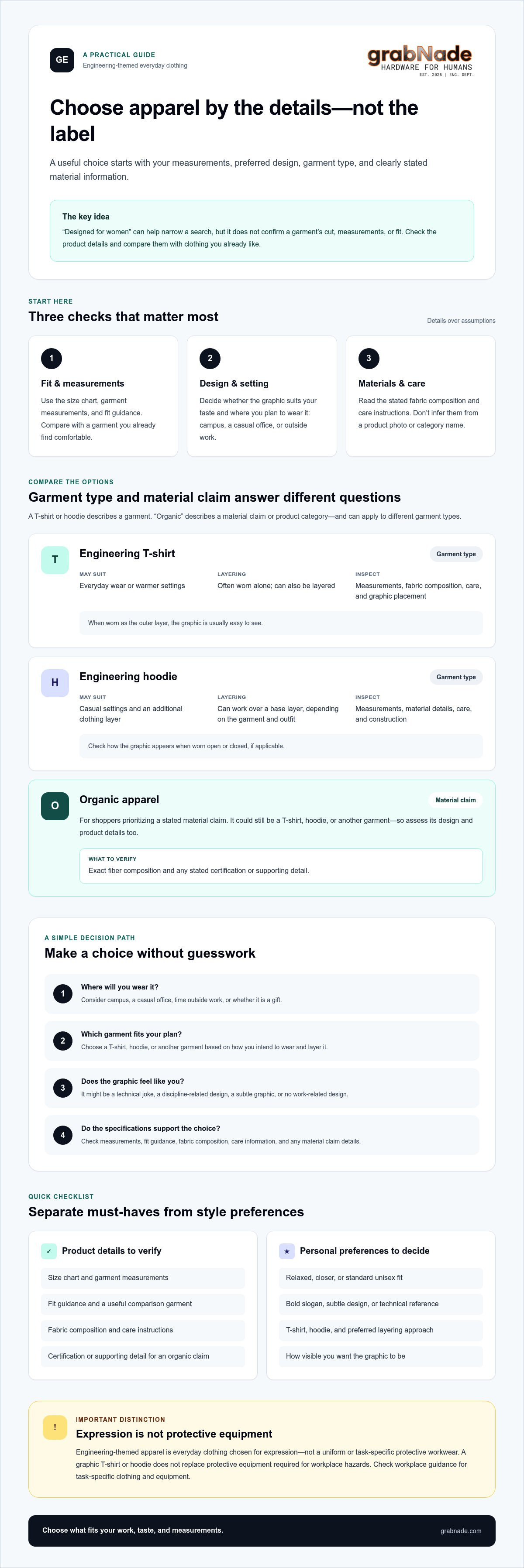
A reliable shortlist starts with your priorities, not the product photos. Use this sequence to compare female engineer apparel for yourself or someone else:
- Define the use. Decide where and how often the garment is likely to be worn, such as casual office days, campus, or time outside work.
- Choose the garment type. Pick a T-shirt or hoodie based on the setting and whether layering matters.
- Check the fit. Look for measurements and sizing guidance for the specific item. Compare them with a garment that fits the wearer well.
- Review the materials. Read the listed composition and care instructions. Verify any organic or certification language on the product page.
- Assess the design. Decide whether the graphic or message suits the wearer’s interests, humour, and personal style.
Separate must-haves from preferences. Must-haves might include available measurements, a stated composition, or a garment type suited to the intended setting. Preferences might include a particular graphic style or the option to layer. This distinction helps you compare products on evidence first, then choose among the options that meet your baseline.
Designs in a women's cut
- Women's Root Cause Not Excuses: for reliability and QA problem solvers
- Women's Ra vs Rz Metrology: for the people who catch the Rz extremes
- Women's Good Fast Cheap: for PMs and TPMs
Browse more in Women's Engineer T-Shirts.
Which Questions Should You Ask Before Comparing Products?
Start with the wearer’s routine: where will the garment be worn, and how often? Then rank the main decision factors. Is fit the priority, or are you mainly looking for a particular design, an extra layer, or a stated material preference? For gift buyers, consider what you know about the recipient’s usual clothing and engineering interests rather than assuming all engineers like the same jokes or graphics.
Finally, check whether each product page provides enough detail to answer those priorities. A compelling design can’t resolve an unanswered sizing question, and a category name alone can’t confirm fabric composition.
How Do You Make a Shortlist You Can Trust?
Compare only options with enough confirmed information to assess them fairly. Track garment type, measurements, composition, care instructions, design, and availability in a simple note or table. Mark missing details as questions, not assumptions. If measurements, material claims, or current availability remain unclear, pause and seek confirmation before deciding.
For a gift, the 2026 engineer gift guide offers another reference point. Once your criteria are clear, compare grabNade’s engineering apparel against them, checking the details on each product page before choosing.
Explore grabNade Female Engineer Apparel and Choose Your Next Step
Once you’ve narrowed down your priorities, compare them with grabNade’s engineering-focused apparel. The brand’s products are created by people with engineering experience, bringing a practical perspective to designs for engineers, designers, and builders. That background can inform relevant designs, but it doesn’t replace product specifications. Check fit, fabric, and garment details for each item.
Confirmed apparel categories include women’s engineering T-shirts, engineering T-shirts, engineering hoodies, and organic apparel. They offer different starting points, not automatic answers. A women’s category may help you find designs aimed at women engineers, while broader engineering tees and hoodies provide additional garment choices. Organic apparel is another category to explore, but check each product’s listed composition and any certification details before drawing conclusions about its materials.
What Does grabNade Bring to Engineering Apparel?
Engineering experience offers a useful design point of view: technical humour, references, and themes can come from an understanding of the work rather than generic ideas about what an engineer might like. That perspective may help you find a design that connects with your interests or profession. It doesn’t mean every graphic will suit every discipline or personality. Your criteria remain the filter.
Use the same standard whether you’re shopping for yourself or someone else. Think about the wearer’s preferred garment type and design style, then confirm that the product page gives enough detail to make a sound choice. Don’t infer a specific fit, fabric, or performance from the category name or engineering theme.
What Should You Confirm Before Choosing a Product?
Check the current product page before deciding. Look for the details that matter to your priorities:
- Fit: Review available garment measurements and sizing guidance.
- Materials: Check the stated composition and any supporting information for organic claims.
- Care: Read the listed instructions so you know what garment care involves.
- Design: Confirm the graphic and wording match your preference.
- Availability: Verify the item’s current status directly on its page.
If one of your must-haves is unclear, pause rather than filling the gap with an assumption. Then use your shortlist to choose among the available T-shirts, hoodies, or other confirmed apparel categories. To put your research into practice, explore grabNade apparel and compare individual product details with your criteria.
Choose Apparel That Works for You
The right female engineer apparel isn’t defined by a label. Start with where you’ll wear it, then compare garment type, actual measurements, listed materials, and design. A clear size chart and product description are more useful than assumptions based on a category name or photo.
grabNade is founded and operated by someone with an engineering background, and its products are created by people with real engineering experience. Confirmed categories include women’s engineering T-shirts, engineering T-shirts, hoodies, and organic apparel. Check each product page for current fit, fabric, care, design, and availability details before choosing.
Keep your must-haves clear, leave room for personal preference, and choose a design that feels like yours. Ready to compare options against your checklist? Explore grabNade engineering apparel and make your next choice with confidence.
Frequently Asked Questions
What is female engineer apparel?
Female engineer apparel is engineering-themed clothing chosen by women engineers or people buying for them. It can include T-shirts, hoodies, and other apparel, but the term doesn’t specify a cut, colour, or style. Check each product’s measurements and details rather than relying on its label. Everyday engineering-themed clothing expresses professional interests; it doesn’t replace protective workwear required for particular tasks on the job.
What should I look for when buying women’s engineering T-shirts?
Start with the product’s measurements and compare them with a T-shirt you already own. Then review the graphic, listed fabric composition, care instructions, and intended use. A size label and product photo can’t answer every fit or material question. If information is missing or unclear, ask the seller to confirm it before deciding. Choose a design that suits your taste, not assumptions about how women engineers dress.
How do I choose between an engineering T-shirt and a hoodie?
Choose based on where and when you plan to wear it, whether you want an extra layer, and which garment fits your wardrobe. Compare the product details, including measurements, materials, and care instructions. A hoodie is a layering option, not a guarantee of a particular warmth level. Check the specific product’s information before comparing options or ordering, especially if fit or fabric details are priorities.
Is organic engineering apparel always certified organic?
No. The phrase “organic apparel” alone doesn’t confirm a particular certification or standard. Check the product description for its exact material composition and any named certification, then verify the claim before relying on it. If the page doesn’t provide certification details, don’t assume the item is certified. This distinction helps you compare products accurately and separate a general material description from a stated credential.
How can I tell whether women’s engineering apparel will fit?
Review the specific product’s size chart, garment measurements, and fit notes, if provided. Compare the measurements with a similar item you own, using the same measuring method. Size labels can vary between garments, so they aren’t a substitute for measurements. If the available fit information is missing or unclear, ask the seller to confirm the relevant details before choosing. Avoid guessing from a product photo alone.
Can female engineer apparel be suitable for professional settings?
It depends on the workplace, the garment, and any dress or safety requirements that apply. Engineering-themed clothing may suit some everyday professional settings, but it isn’t protective equipment. Check workplace rules and the garment’s product details before wearing it on site. If a task requires protective clothing, use equipment specified for that task. Don’t rely on an apparel design as a substitute for required protection.
Where can I find engineering apparel designed with engineers in mind?
Look for brands that explain who creates their designs and who they serve, then check product pages for clear measurements and material details. grabNade says its products are created by people with engineering experience and offers women’s engineering T-shirts, engineering T-shirts, hoodies, and organic apparel. Review each product page to confirm current designs, fit and fabric information, care details, and availability before choosing.