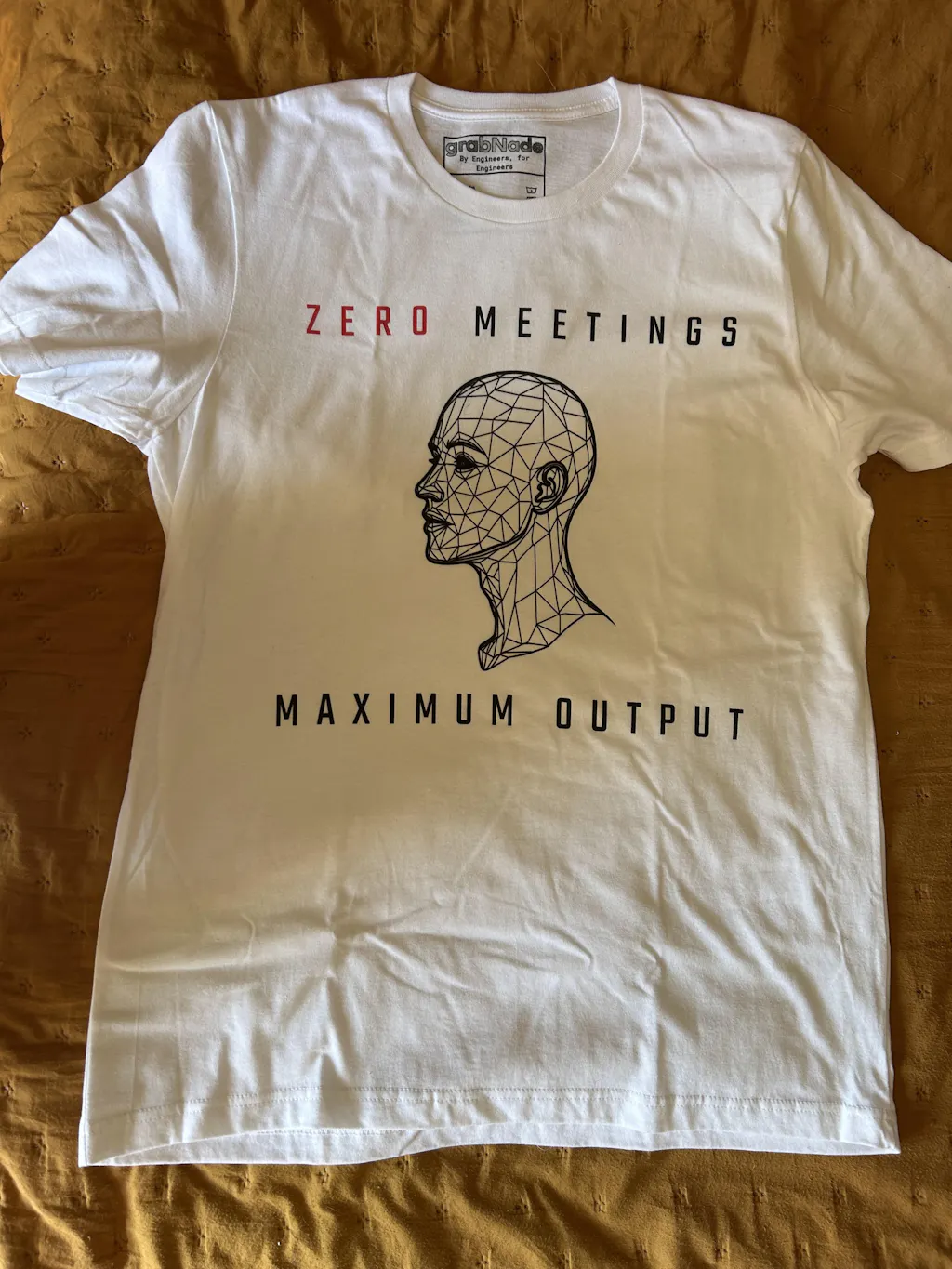
Zero Meetings Maximum Output
Share
Zero Meetings.
Maximum Output.
Every engineer has lived through a day like this: three hours of back-to-back meetings in the morning, a lunch interrupted by a Slack notification that required 40 minutes to resolve, two more hours of meetings in the afternoon, and an evening spent catching up on the actual work. The ticket that was supposed to take a focused morning took three days.
This isn't a productivity problem. It's a physics problem. And the physics has a name: deep work.
## 01. THE COST OF AN INTERRUPTION
Research by Gloria Mark at UC Irvine found that after an interruption, it takes an average of 23 minutes to return to the original task at full cognitive engagement. Not to restart the task — to return to the same level of focus that existed before the phone rang, the Slack message appeared, or someone stopped by the desk.
For an engineer doing complex work — designing a system, debugging a difficult problem, writing a specification, reviewing a calculation — the cost is higher. Engineering work requires holding large amounts of context in working memory simultaneously: the architecture, the constraints, the failure modes, the trade-offs, the history of decisions that led to the current state. That context doesn't survive an interruption. It has to be rebuilt from scratch every time.
## 02. DEEP WORK vs SHALLOW WORK — THE DISTINCTION THAT MATTERS
Deep work is cognitively demanding professional activity performed in a state of distraction-free concentration — the kind that pushes cognitive capability to its limit and creates new value. It's what produces the design that solves a hard constraint, the analysis that finds the failure mode nobody else found, the algorithm that cuts processing time by 60%.
Shallow work is non-cognitively demanding logistical-style tasks, often performed while distracted — responding to emails, attending status update meetings, filling in reports, updating tickets. It's necessary but replaceable. It doesn't require the engineer's specific expertise. It just requires the engineer's time.
The problem in most engineering organisations is not that shallow work exists. It's that shallow work has colonised the hours that should belong to deep work — and the two are incompatible. You cannot do deep work in 20-minute gaps between meetings. The depth simply cannot be reached in that time.
## 03. WHY ENGINEERING SPECIFICALLY SUFFERS
Not all knowledge work is equal. A salesperson can make a call, take a break, and make another call — the calls are largely independent. A writer can draft a paragraph, respond to an email, and return to the draft. The context load is manageable.
An engineer designing a complex system is holding an interconnected web of constraints, dependencies, and implications. Interrupting that state doesn't just pause the work — it collapses the mental model that took 45 minutes to build. Returning to the problem means rebuilding it, which takes time and costs quality — the rebuilt model is rarely as complete as the original.
This is why the most productive engineers are often the ones who seem least "busy." They're not in meetings. They're not visibly responsive. They're in a state that, from the outside, looks like they're just sitting at a desk. What's actually happening is the most valuable cognitive work the organisation is capable of producing.
## 04. HOW TO PROTECT DEEP WORK TIME — IN PRACTICE
Block It on the Calendar
Deep work time that isn't calendared doesn't exist — it will be filled by meetings. Block 2–4 hour chunks daily as recurring events. Label them "Focus Block" or "Engineering Time." Treat them as non-negotiable as any meeting. The calendar is the first line of defence.
Batch Shallow Work
Email, Slack, status updates, and quick questions don't need real-time responses. Designate two fixed windows per day — morning and late afternoon — for shallow work. The rest of the time, notifications are off. Most "urgent" messages are urgent only by the sender's definition.
Audit the Meeting Load
For every recurring meeting, ask: does my presence change the outcome? If the answer is no — decline. A meeting that requires an engineer's presence but doesn't benefit from their specific input is shallow work wearing a collaboration costume. The default should be written updates, not synchronous attendance.
Communicate the Protocol
Deep work scheduling only works if the team understands and respects it. A quick explanation — "I have focus blocks from 9–12 daily, I'll respond to messages after noon" — sets expectations and reduces the social friction of being unreachable. Most colleagues accept it immediately when it's explained.
Measure Output, Not Presence
The engineering manager who measures productivity by meeting attendance and response time is optimising for the wrong metric. The right metric is output quality and velocity — how good is the work, and how fast does it move. Engineers who protect deep work typically score higher on both.
Design the Environment
Noise-cancelling headphones, a closed door, a dedicated workspace, or a different physical location — anything that creates a clear environmental signal of "in deep work mode" helps both the engineer and their colleagues. The environment is not just comfort. It's part of the cognitive stack.
## 05. THE MEETING THAT COULD HAVE BEEN AN EMAIL
There is a specific meeting type that every engineer recognises immediately: the status update meeting. Fifteen people in a room (or a video call), each presenting for five minutes what they did last week and what they're doing this week. Total duration: 90 minutes. Information density: achievable in a shared document that everyone reads in 10 minutes, asynchronously, without interrupting anyone's deep work.
The meeting exists not because it's the most efficient way to share information, but because it's the most visible. Attendance can be counted. Faces can be seen. The manager feels informed. The engineers in that meeting have lost 90 minutes of their most valuable cognitive resource — and the organisation hasn't noticed, because busyness and productivity look identical from the outside.
## 06. THE ENGINEERING CASE FOR ASYNC CULTURE
The most productive engineering organisations — distributed teams in open source, remote-first companies, elite research labs — share a common pattern: they default to asynchronous communication. Decisions are documented. Questions are written down with enough context to be answered without a call. Progress is tracked in shared systems, not meetings.
This isn't anti-social. It's a rational response to the cognitive cost of interruption. A culture of async communication is a culture that takes deep work seriously — and deep work is where engineering value is created.
Zero meetings is a provocation, not a policy. Some meetings are necessary, valuable, and irreplaceable. The design review that surfaces a critical issue before production. The retrospective that changes how the team works. The one-on-one that solves a problem that no document could address. These meetings have a clear return on the time they cost.
The others — the status updates, the alignment calls, the "let's discuss this live" conversations that resolve in three Slack messages — those are the ones engineers are opting out of when they say zero meetings, maximum output. They already know which meetings those are.
// grabnade.com · apparel
Zero Meetings.
Maximum Output.
For the engineer who has declined a meetingand shipped more before lunch
than the rest of the week combined.