
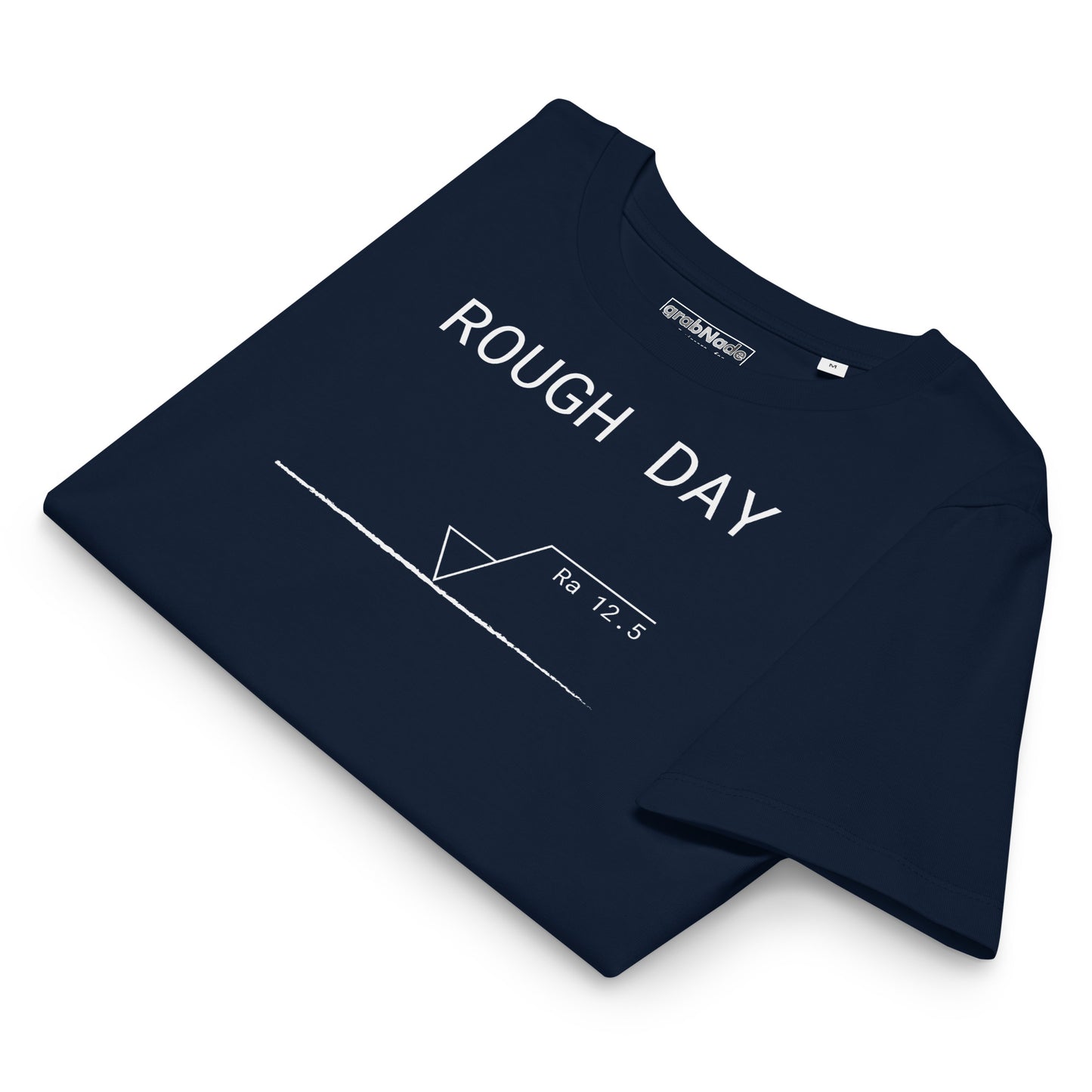
Rough DayWoman Premium Organic Cotton Tee180 GSM
When the surface roughness is off, you know it's going to be a rough day. For engineers who live by Ra values.
Product Certifications
-

WRAP / Fair Labor
-

100% GOTS & Eco-Inks


Couldn't load pickup availability
-
30-Day
Failure Analysis -
Free Shipping
Protocol Lead time: 5-11 days -
Encrypted
Transaction


💚 Zero Inventory. Produced on-demand to eliminate waste.
Swiss-Grade Data Privacy ▼
Your data is stored in Geneva, Switzerland. Never sold, never used to train AI models without consent.
View Digital Infrastructure Spec →
PREMIUM PRODUCT DETAILS
PREMIUM PRODUCT DETAILS
THIRD-PARTY CERTIFICATIONS
THIRD-PARTY CERTIFICATIONS
SUSTAINABILITY
SUSTAINABILITY
CARE INSTRUCTIONS
CARE INSTRUCTIONS
Maintenance Protocol
-

Wash cold (30°C / 86°F), inside out, with similar colors.
Use mild detergent. No bleach. No softeners.
-

Do not bleach. Chlorine degrades organic fibers.
Use oxygen-based stain removers if necessary.
-

Tumble dry Low or Hang dry (Recommended).
Optimum: Flat air dry to preserve fiber tension.
-

Iron on Low Heat if needed. Do NOT iron prints.
Fabric naturally resists wrinkling post-wash.
-

Do not dry clean. Chemical solvents damage prints.
-

Oeko-Tex™ Certified water-based inks.
New scent? It's the fixation agent. Disappears after 1st wash.
TRACEABILITY
TRACEABILITY
REGULATORY SPECS (GPSR)
REGULATORY SPECS (GPSR)


Knowledge Base: Technical Specs & Logistics
Knowledge Base
Technical specifications, protocols, and operational data.
A Material Specifications
A1 What defines "Airlume Combed" cotton?
Mechanical Purification. Unlike standard carded cotton, Airlume combing removes 25% of raw impurities and short fibers. This results in a tighter weave surface (smoother for printing) and superior resistance to pilling.
A2 Why use GOTS Certified Organic?
Chemical-Free Agriculture. Our Organic Premium line uses 100% GOTS certified cotton, grown without GMOs or synthetic pesticides. It requires less water and maintains soil health.
A3 What does "Pre-shrunk" mean?
Controlled Stabilization. The fabric is washed and dried *before* garment construction. This minimizes post-purchase shrinkage to <3%.
A4 What is your printing technology?
Kornit DTG Systems. We use Direct-to-Garment printers with water-based Neopigment™ inks. These inks are OEKO-TEX Eco Passport certified.
B Sustainability Protocols
B1 How does On-Demand reduce waste?
Zero Inventory Model. We produce nothing until an order is confirmed. One shirt ordered = one shirt made. This eliminates the industry-standard 30% waste of unsold stock.
B2 Is manufacturing ethical?
Non-negotiable. All production partners comply with WRAP (Worldwide Responsible Accredited Production) and FLA (Fair Labor Association) standards.
B3 Where is the engineering methodology?
We've documented impact metrics and material physics in our technical whitepaper.
C Digital Infrastructure
C1 How is the website "carbon neutral"?
Solar-Powered Logic. Our host, Infomaniak (Switzerland), runs on 100% renewable energy and offsets 200% of residual emissions.
C2 How do servers heat homes?
Thermal Recycling. Instead of using A/C, our data center captures server waste heat and injects it into the Geneva district heating grid.
C3 Is my data secure?
Swiss Data Sovereignty. Your data is stored in Geneva under the strict Federal Act on Data Protection (FADP). No resale. No AI training.
D Maintenance Protocols
D1 Standard Care Procedure
- Wash: Machine wash cold (30°C), inside out.
- Dry: Hang dry (Preferred) or Tumble Low.
- Iron: Low heat, inside out. Never iron prints directly.
D2 Hang Dry vs. Tumble Dry
Hang Dry (Recommended): Extends fiber tensile strength by 40-60%.
Tumble Dry Low: Acceptable for convenience, but increases micro-abrasion over time.
E Sizing & Fit
E1 Which quality tier matches my needs?
- Ultra-Soft Premium: Maximum softness, retail fit.
- Organic Premium: Eco-priority, GOTS certified.
- Standard Premium: Balance of durability and value.
E2 How to determine my size?
Measure, don't guess. Lay your best-fitting tee flat. Measure width (armpit to armpit). Compare with the "Hardware Specs" table on any product page.
F Logistics & Fulfillment
F1 Total Lead Time Calculation
Total = Production (2-5 days) + Transit.
- USA: 5-11 business days total.
- Europe/UK: 6-12 business days total.
F2 Tracking Telemetry
End-to-End. You receive a tracking link immediately upon label generation. Monitoring is available via your account dashboard.
F3 Return Policy Protocol
We accept returns for defects, damage, or sizing errors within 30 days. As a zero-inventory brand, we encourage precise sizing.
G Company Data
G1 Origin Story
Founded in 2025. grabNade creates "Hardware for Humans"—applying engineering rigor to apparel essentials.
G2 Retail Availability
DNVB Model. We operate exclusively online to eliminate retail markups and maintain a direct feedback loop with our users.
G3 Bulk Orders
Yes. For team deployments (20+ units), contact engineering support.
H Account Data
H1 Data Purge Protocol
To exercise your GDPR "Right to be Forgotten", log in to Privacy Settings and select "Delete My Account". Execution time: <72 hours.
Color Accuracy Assurance
Color Calibration & DTG Specification
An engineering guide to color reproduction on textile substrates.
1. Color Model Physics
The perceived difference between screen and fabric originates in fundamental physics. Your monitor operates on an **additive** light model (RGB), while printing uses a **subtractive** pigment model (CMYK).
RGB (Screens)
- Method: Additive (Emits Light)
- Gamut: Wide, vibrant
- Use Case: Digital Displays
CMYK (Print)
- Method: Subtractive (Absorbs Light)
- Gamut: Narrower, physical
- Use Case: Textile & Paper
Therefore, a direct 1:1 color match is impossible. We calibrate our workflow for maximum fidelity *within the CMYK gamut*.
2. Key Process Variables
- Substrate Texture: Ink absorption varies between 100% combed cotton and heather blends (Cotton/Poly), creating subtle differences in saturation.
- Underbase Application: Dark garments require a white underbase layer for vibrancy. This adds negligible thickness and a unique hand-feel to the print area.
- Viewing Environment (Metamerism): Color perception will shift between daylight (D65), office fluorescent, and warm indoor lighting. This is an optical property, not a defect.
3. Acceptance Criteria & Safety
We use industry-leading Kornit DTG systems to guarantee process consistency.
✅ OEKO-TEX® Certified Inks
All prints use water-based inks certified under Eco Passport. They are free from harmful substances, validating them as safe for direct skin contact. View Certifications →Our standard guarantees sharp detail and color durability as per our maintenance protocols. Slight variations in ink absorption are not defects, but hallmarks of genuine textile printing vs. mass-produced heat-transfer vinyl (HTV).