Sustainable Engineer Apparel: A Practical Framework for Better Choices
What makes sustainable engineer apparel a better choice isn’t necessarily a bold green label. If you’ve tried comparing fabric claims and sustainability badges, you know they don’t always make the decision clearer. A material can be a useful starting point, but it can’t tell you everything about how a garment was made, how long it may stay useful, or what happens when you’re done wearing it.
For engineers, apparel also has to work in real life. Comfort, function, and durability matter alongside environmental considerations. A garment that doesn’t suit your routine or gets pushed to the back of the wardrobe isn’t a practical choice, whatever the label says.
This guide offers a practical framework for assessing engineer-focused apparel across its lifecycle. You’ll learn what to check in material descriptions and production evidence, how to assess labels and claims that deserve a closer look, and why garment lifespan and end-of-life options belong in the same decision. The goal isn’t to find a perfect fabric or a reassuring badge. It’s to make a better-informed choice based on evidence, intended use, and the garment’s full lifecycle.
Key Takeaways
- Assess sustainable engineer apparel across materials, production, use, care, and disposal rather than relying on a single fibre or label.
- Separate material information from evidence about dyeing, finishing, manufacturing, and supply-chain traceability.
- Compare claims by checking their scope and supporting evidence, then ask what the information means for the specific garment.
- Use a practical sequence: define how you’ll wear the item, inspect its composition, review evidence, and consider care and fit for purpose.
- Apply the same criteria to engineer-focused everyday clothing, including apparel designed with engineering experience in mind.
What Makes Sustainable Engineer Apparel More Than a Fabric Choice?
Assess sustainable engineer apparel across its full lifecycle: materials, production evidence, use, care, and disposal. A fibre description is one product specification, not a complete assessment. The broader idea of Sustainable fashion also considers how clothing is produced, used, and kept in circulation. That’s why no single fibre, label, or slogan can prove a garment is sustainable on its own.
Why one “sustainable” material cannot tell the whole story
Organic, recycled, and conventional describe different aspects of a material. “Organic” refers to how a fibre was grown under a particular standard; “recycled” indicates that some material comes from reclaimed feedstock. Conventional fibres make neither claim by default, but that alone doesn’t establish how responsibly a garment was made or how long it will stay useful. No category is automatically the best choice for every application.
Look beyond the fibre name. Check what the garment is made from, whether the claim applies to the whole item or only one component, and what evidence supports it. Production details, care needs, expected use, and disposal options also inform the assessment. If a product mentions a certification, verify that it applies to that specific product and understand what its scope covers. Check product composition and certification individually instead of inferring them from a brand-level statement.
What makes apparel relevant to engineers’ everyday work
Engineer-focused everyday clothing may be worn on a commute, in an office, around design spaces, or off duty. Its usefulness depends on your routine: whether it’s comfortable, appropriate, and likely to be worn regularly. Fit and function aren’t environmental proof, but a garment that suits its intended use is more likely to earn a place in regular rotation.
Keep everyday apparel separate from certified protective workwear. An engineer-themed T-shirt or hoodie doesn’t provide protection from workplace hazards unless the item is specifically documented and certified for that purpose. Check your site’s requirements and the garment’s stated specifications. Don’t treat a graphic, fabric claim, or general sustainability label as safety equipment.
For a closer look at how design intent and technical details shape engineer-oriented clothing, see this engineer uniform and technical specs guide. The same practical mindset applies here: define the use, inspect the evidence, and assess the garment on its details rather than its headline claim.
How Materials and Production Shape Sustainable Engineer Apparel
Material names describe inputs, not the complete production system. Organic cotton refers to cotton grown under an organic standard; recycled polyester indicates polyester made using recycled feedstock. Conventional fibres make neither claim. Each category offers a different piece of information, but none is a universal sustainability winner. Fibre content alone doesn’t tell you how a garment was dyed, finished, assembled, transported, or designed for end of life.
Organic and recycled fibres: what the labels do and do not establish
Look for the exact fibre composition and the share of each fibre in the finished garment. A blended textile, for example, may combine fibres with different sourcing claims and recycling options. Then check whether a label or certificate applies to the specific product, the material, or another part of the supply chain.
The Global Organic Textile Standard (GOTS) sets requirements for the processing of textiles made with organic fibres, along with environmental and social criteria across covered stages. A general “organic” description isn’t proof of GOTS certification. Verify the product’s certification and scope before relying on that claim.
A material attribute describes an input; independently verified product certification confirms that a defined standard applies within a stated scope.
Production evidence and textile standards worth checking
Raw-material sourcing is only one control point. Dyeing and finishing can involve different processes, while manufacturing information can help show where and under what standards a garment was made. Traceability is useful when a claim identifies the product and connects it to supporting documentation.
OEKO-TEX is a family of textile-related labels and standards, not a general certificate that resolves every sustainability question. For example, STANDARD 100 concerns testing for harmful substances in textiles. Check the specific label, its scope, and whether the claim can be verified for the item you’re considering. A certificate focused on one issue shouldn’t be read as proof of responsible farming, fair working conditions, durability, or recyclability.
Use a simple evidence check:
- Product: Does the claim identify the garment, rather than the brand generally?
- Material: Is the fibre composition disclosed, including blends?
- Standard: Is the certification named, with its scope explained?
- Verification: Can you identify the certifying body or supporting documentation?
Broad environmental wording deserves scrutiny. The FTC's Green Guides offer guidance on environmental marketing claims. Use them as a reference when assessing whether a statement is specific and supported. For a practical comparison, you can also review grabNade’s engineer-focused apparel, then check each item’s own composition and certification details rather than assuming a category claim applies to every product.
How to Compare Sustainable Engineer Apparel Claims Without Greenwashing
Compare product details, not polished wording. A useful claim names what it refers to and gives you a way to check it. A credible claim identifies its scope and points to supporting evidence. Use the framework below to assess sustainable engineer apparel across material, production, and everyday performance.
| Claim | Evidence to seek | Question to ask |
|---|---|---|
| “Made with organic cotton” | Full fibre composition and a product-level certification, if one is claimed | Does the claim cover the whole garment or only a component? |
| “Certified” or a named standard | The specific standard, covered product or material, and certifying body | What does this certification assess, and what falls outside its scope? |
| “Responsibly made” | Named manufacturing locations, production information, or traceability details | Can I connect this statement to the garment I’m considering? |
| “Built for everyday wear” | Construction details and a clear description of intended use | Does it suit my routine, and is the information specific enough to assess? |
| “Easy to care for” | Care instructions on the product or garment label | Can I follow the care guidance with my normal routine? |
Which certifications and claims deserve a closer look?
Certifications are scoped standards, not blanket approvals of every aspect of a garment. Global Organic Textile Standard (GOTS) and OEKO-TEX address defined criteria, but their scopes differ. Check the current standard details and confirm whether the specific product, fibre, or component is covered. A logo without identifiable product-level information leaves key questions unanswered.
Terms such as “eco-friendly” or “green” don’t tell you which impact is being claimed or what evidence supports it. Treat them as prompts to ask for specifics, not as proof. The Centre for Sustainable Fashion offers broader perspectives on applying sustainability in fashion, while a product comparison still requires evidence for the item itself.
Durability, use, and care are part of the comparison
A garment’s practical value depends on whether it fits your routine and is comfortable and appropriate enough to wear regularly. Check construction details and intended use instead of assuming a broad durability claim guarantees a particular lifespan. Care instructions tell you what the garment requires, not its total environmental impact.
For an example of how to examine construction and intended use in engineer-focused clothing, see this engineering hoodie technical guide. Compare equivalent details across garments, then note which claims are documented, which remain vague, and which questions still need answers.
A Practical Checklist for Choosing Sustainable Engineer Apparel
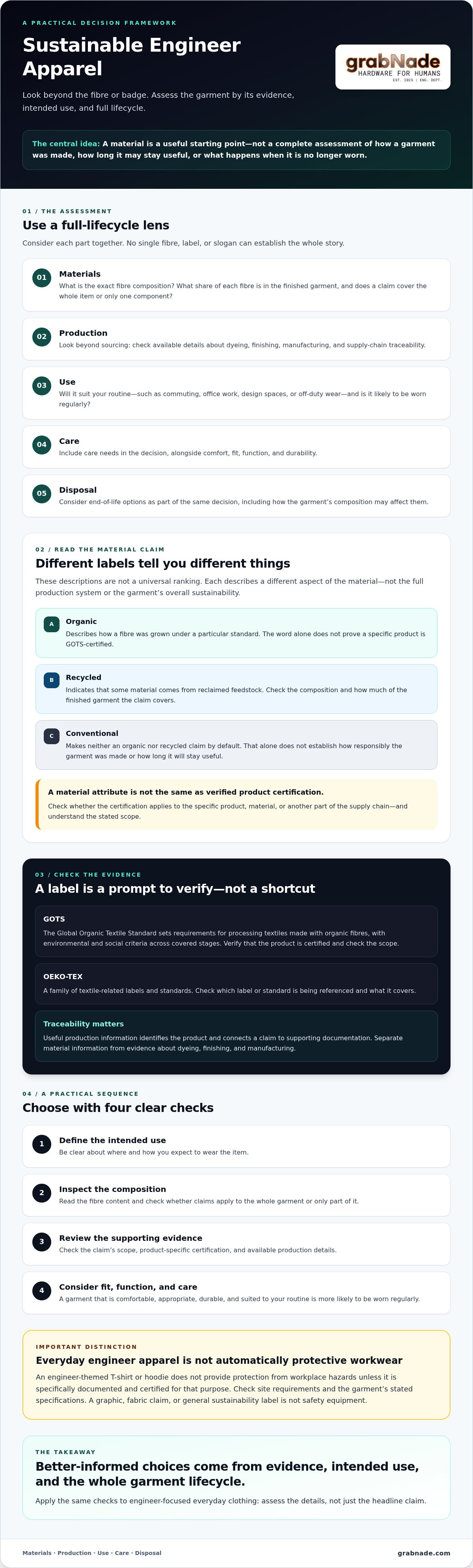
Use the same assessment for each garment. That makes comparisons fairer and keeps broad brand language from standing in for product-level evidence. This five-step process turns the lifecycle framework into a practical purchase check.
A five-step product assessment you can reuse
- Define the use. Decide where you’ll wear the garment, how often, and what it needs to do. A T-shirt for office days has different requirements from a layer you’ll wear on a commute or during off-duty activities.
- Inspect the composition. Find the fibre content for the specific item. Check whether it lists a single fibre or a blend, and note any percentages provided.
- Check the evidence. If a certification or environmental claim is stated, confirm which product or component it covers. Look for the standard, its scope, and verifiable supporting details.
- Assess care. Read the care instructions and decide whether they fit your usual routine. Treat them as practical guidance, not a guarantee of environmental performance or garment lifespan.
- Decide whether it suits you. Weigh the available evidence against fit, design relevance, comfort, and intended use. A garment you’re unlikely to wear regularly may not be useful for your needs.
Compare like with like: product composition beside product composition, certification scope beside certification scope, and care instructions beside care instructions. Don’t compare one item’s specific documentation with another brand’s general sustainability statement and call the result conclusive. The aim is to make an informed decision from the information available, not to award a perfect score based on a single label.
Organic and certified options
- Kaizen Safe Word hoodie: 80% organic cotton, 20% recycled polyester
- Never Trust A Blueprint hoodie: the eco raglan version
Browse more in Organic Engineer Apparel.
Questions to ask when product information is incomplete
Missing details leave a gap in the assessment, but they don’t prove a product is either sustainable or unsustainable. Separate what’s documented from what you still need to know. Before deciding, check the product page, label, or certification information for answers to questions like these:
- Is the fibre composition stated for this specific item?
- Does the certification name the covered product or component and explain its scope?
- Does a manufacturing claim identify what was made, where, or under which standard?
- Are the intended use and care instructions clear enough to assess against your routine?
If a claim stays vague, seek clarification or treat it as unverified rather than filling in the blanks. This method works across sustainable engineer apparel, from everyday T-shirts to hoodies. Ready to apply the checklist to engineer-focused clothing? Explore grabNade engineer apparel.
How Engineer-Focused Apparel Can Put the Framework into Practice
The lifecycle framework applies to everyday engineer-oriented clothing just as it does to any other garment. Start with the intended use, then check the material and production information available for the specific item. Consider care requirements and whether its fit, design, and function make it something you’ll actually wear. An engineering theme may make a garment relevant to your interests, but it isn’t evidence of environmental performance.
What engineering experience contributes to apparel design
Apparel designed by people with engineering experience can reflect familiarity with the community and its everyday interests. That perspective may help inform design relevance and intended use. It doesn’t, by itself, establish fibre sourcing, manufacturing conditions, durability, or environmental impact.
Apply the same practical test to engineering T-shirts, hoodies, and women’s engineering T-shirts: does the item suit your routine, feel appropriate for where you plan to wear it, and fit well enough to earn regular use? These factors help assess usefulness. They don’t replace product-level evidence about materials or production.
What to verify before making a product-level sustainability claim
grabNade offers engineer-focused apparel designed by people with engineering experience, as well as an organic apparel category. Keep those facts separate from any claim about a specific garment’s sustainability. The category name alone doesn’t confirm a product’s fibre composition, GOTS certification, or overall environmental performance.
Before describing or choosing an item based on a sustainability claim, check current product documentation. Confirm the composition, identify whether a stated certification covers that exact product or component, and look for supporting information about production. Then compare what the evidence actually establishes with the garment’s intended use and care guidance.
A useful final review is straightforward:
- Evidence: What product-specific material or certification details are available?
- Use: Does the garment fit your actual routine and suit where you’ll wear it?
- Care: Can you follow its care instructions as part of normal use?
- Suitability: Do the design, fit, and available information meet your needs?
This is the working standard for sustainable engineer apparel: assess the evidence, match the garment to its intended use, and avoid claims that go beyond what the documentation supports. To browse engineer-focused T-shirts, hoodies, and organic apparel, explore grabNade apparel.
Make Your Next Apparel Choice With Better Evidence
Sustainable engineer apparel isn’t defined by one fibre or label. Assess the full picture: material and production evidence, care requirements, intended use, and whether the garment suits your routine. Compare product-level details, and treat broad claims as questions to verify rather than proof.
Engineering experience can help inform apparel design and relevance, but it doesn’t establish a product’s environmental performance. grabNade’s engineer-focused apparel is designed by people with engineering experience, and organic apparel is available as a category. Check the composition and certification of each specific product before making sustainability claims.
Ready to put the framework into practice? Explore engineer-focused apparel from grabNade, review the details, and choose what fits your needs with confidence.
Frequently Asked Questions
What makes engineer apparel sustainable?
Engineer apparel is more sustainable when its materials, production evidence, useful life, care needs, and end-of-life options are considered together. No single fibre or label settles the question. Check the garment’s composition and any product-specific certification, then assess whether its fit and function suit your routine. A well-supported claim should make clear what it covers and provide evidence you can verify, rather than relying on broad language alone.
Is organic cotton automatically more sustainable than conventional cotton?
No. “Organic” describes how cotton is grown under a defined standard, but it doesn’t establish the full impact of the finished garment. Processing, dyeing, manufacturing, transport, care, and product lifespan also matter. Compare specific evidence rather than assuming one fibre category is always better. If a product claims organic cotton, check the composition and whether any named certification applies to that specific garment or material.
What does GOTS certification mean for a T-shirt?
Global Organic Textile Standard (GOTS) sets requirements for textiles made with organic fibres and covers defined environmental and social criteria across specified processing stages. For a T-shirt, verify that the certification applies to the product or relevant component, rather than assuming a general brand claim covers every item. Check current certification details and scope. GOTS addresses defined criteria; it isn’t proof that every sustainability concern has been resolved.
Can recycled polyester make engineer apparel sustainable?
Recycled polyester indicates that the polyester fibre uses recycled feedstock, but that fact alone doesn’t establish the garment’s overall sustainability. Check how much of the product is recycled polyester, whether the claim is product-specific, and what evidence supports it. Also consider production information, expected use, care instructions, and end-of-life options. Compare these details with other garments designed for the same purpose, rather than treating recycled content as a complete assessment.
How can I spot greenwashing in sustainable clothing claims?
Look for broad terms such as “eco-friendly” that don’t identify a specific benefit or supporting evidence. Ask what product the claim refers to, what attribute it describes, and whether a named standard or documentation verifies it. Check certification scope instead of relying on a logo alone. If a claim doesn’t say what it covers or how it’s supported, treat it as unverified and seek clearer product-level information before relying on it.
Does durable clothing always have a lower environmental impact?
No. Durability can support longer use, but it doesn’t by itself prove that a garment has a lower environmental impact. The materials, manufacturing, care requirements, and whether the garment actually suits your routine also matter. A durable item that isn’t worn may not deliver the expected use. Review construction and care details where available, and treat lifespan claims cautiously unless the brand provides clear, relevant evidence.
What should I check before buying an organic engineer T-shirt?
Check the T-shirt’s stated fibre composition and confirm what “organic” refers to. If GOTS or another certification is claimed, verify its current scope and whether it covers that specific product or component. Review care instructions, fit, design, and intended use so the item suits your routine. For any product, including grabNade’s organic apparel category, don’t assume a product’s fibre composition or certification without checking its current product documentation.