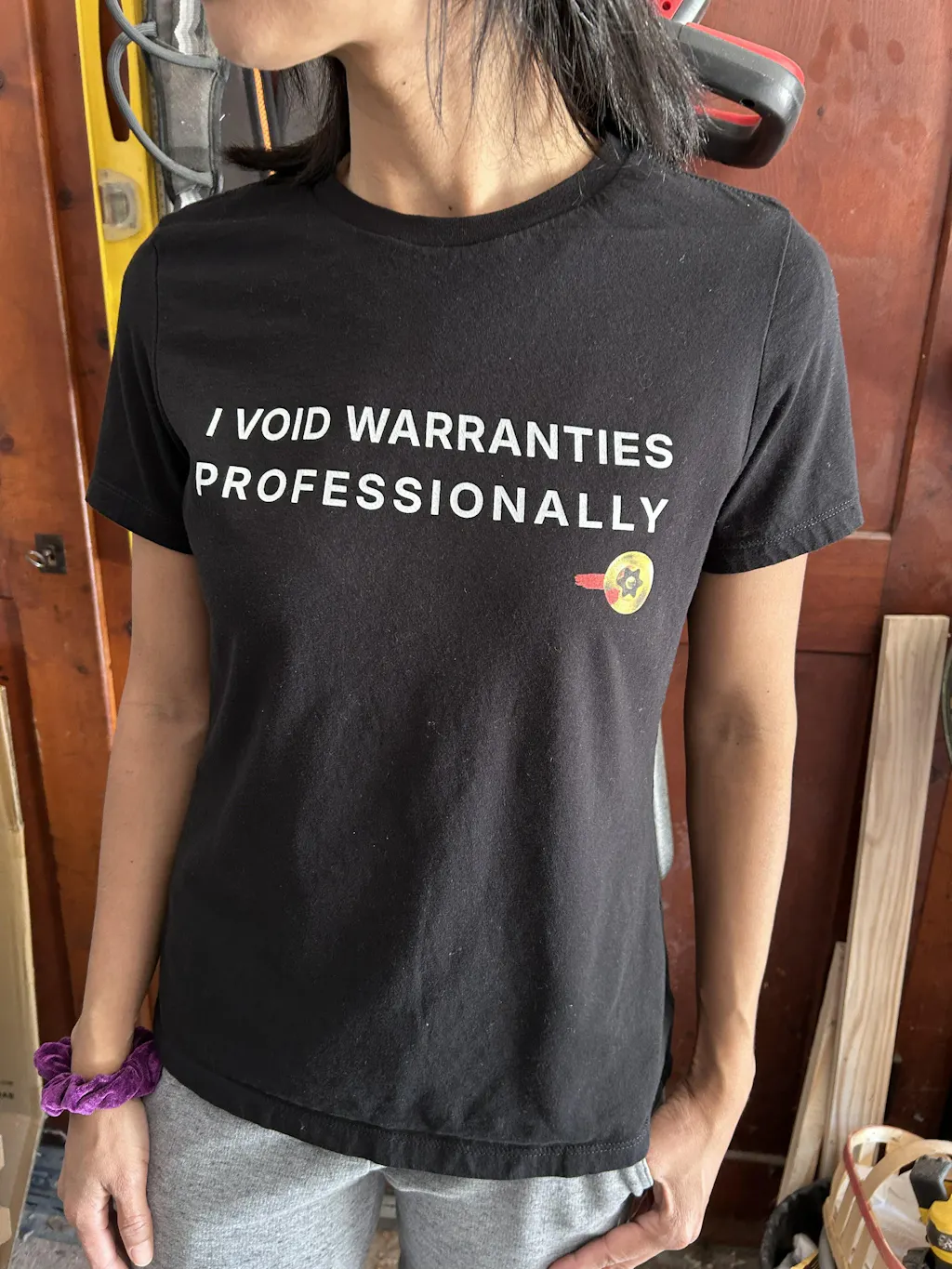
The Engineer’s Uniform: Why Insider Designs and Technical Specs Matter in 2026
Why does the average "teamwork" graphic feature three gears that would physically lock the moment you applied torque? It's a glaring technical blunder that signals a total lack of industry experience. Most engineer t-shirts on the market today are designed by people who have never seen a blueprint or calculated a tolerance. You've likely felt the frustration of wearing apparel that fails on two fronts. It features inaccurate schematics. It uses thin, low-GSM fabrics. It fails to survive a week on the shop floor.
We agree that your professional identity deserves better than generic, cringe-worthy humor. You'll discover why technical accuracy, fabric specifications, and insider identity define a superior garment. We will analyze the transition from disposable fast fashion to apparel built like a spec sheet. You'll learn about the importance of side-seamed construction, 300 DPI print protocols, and why true insider designs only need to be understood by your peers. It's time to treat your wardrobe with the same precision you apply to your CAD files. Design, material, execution. That's the new standard for 2026.
Key Takeaways
- Learn why fabric density (GSM) is a critical specification for shop-floor durability and structural integrity.
- Identify the technical red flags in generic engineer t-shirts, including the physically impossible gear configurations that signal a lack of expertise.
- Understand how discipline-specific design motifs, from GD&T symbols to ASTM standards, validate your professional credibility.
- Apply the Iron Triangle constraint model to your wardrobe to prioritize quality and longevity over disposable fast-fashion alternatives.
- Discover the grabNade protocol for apparel that functions like a technical datasheet, designed by peers who understand the work.
The Technical Anatomy: Decoding Fabric Specifications
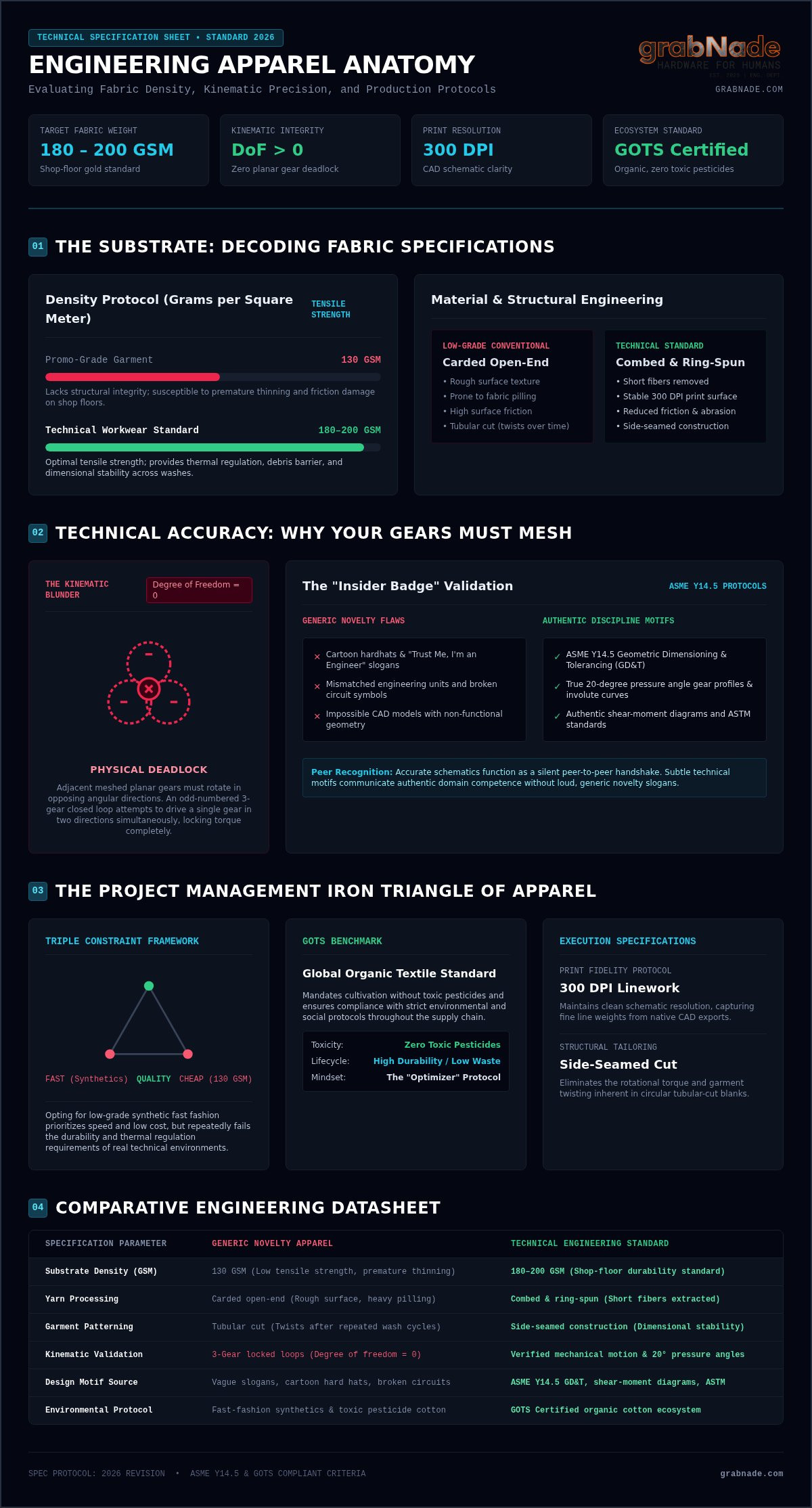
Fabric is your substrate. In the hangar, the lab, or the field, performance overrides aesthetics. For superior engineer t-shirts, the primary metric is GSM (Grams per Square Meter). This value measures fabric density. It dictates structural integrity. It defines resistance. While promo-grade shirts settle for 130 GSM, professional workwear requires the 180-200 GSM gold standard. This weight provides the tensile strength needed for shop-floor environments. It stops the garment from losing its profile. It prevents premature thinning. It ensures the shirt survives the friction of daily technical work.
Material choice follows the density specification. Combed and ring-spun cotton is the professional baseline. Unlike carded open-end cotton, which is rough and prone to pilling, combed cotton removes short fibers and impurities. This process reduces surface friction. It increases comfort. It ensures the print surface remains stable for high-resolution CAD schematics. When you select apparel, you're managing the project management triangle of quality, speed, and cost. Opting for low-grade synthetic blends might be fast and cheap, but it fails the durability test every time.
GSM vs. Thread Count: The Durability Protocol
Density dictates drape. A higher GSM ensures the fabric hangs correctly. It resists the "twisting" effect common in tubular-cut shirts that lack side seams. In technical environments, you need moisture-wicking properties and breathability. High-grade natural fibers at the 180-200 GSM mark offer a thermal regulation advantage. They absorb moisture without becoming heavy. They provide a reliable barrier against minor shop-floor debris. This isn't just a style choice. It's a functional requirement for long-term dimensional stability across repeated wash cycles.
Sustainable Sourcing: The GOTS Standard
Precision extends to the supply chain. The Global Organic Textile Standard (GOTS) is the benchmark for 2026. It ensures the cotton is grown without toxic pesticides. It mandates strict environmental and social criteria. For the technical reader, this aligns with the "Optimizer Mindset." You reduce waste. You increase lifecycle value. You avoid the environmental debt of fast-fashion synthetics. Choosing organic apparel isn't about optics. It's about selecting a high-performance material that respects the ecosystem it operates within. Quality. Integrity. Sustainability.
Technical Accuracy: Why Your Gears Must Mesh
Three planar gears meshed in a triangular cluster represent a known technical blunder. It results in kinematic locking where the degree of freedom equals zero. Adjacent meshed gears must rotate in opposite angular directions. An odd-numbered loop attempts to drive the initial gear in two opposing directions simultaneously. It's a physical deadlock. Yet, this graphic is everywhere on generic engineer t-shirts. It's the ultimate "cringe" for a professional who understands mechanics. Accuracy isn't just a preference. It's a baseline for credibility.
Accuracy signals professional pride. It shows you respect the physics of your discipline. When a design correctly references ASME Y14.5 dimensioning and tolerancing standards, it functions as a peer-to-peer handshake. It validates your identity. Only someone in the trenches recognizes a genuine involute curve or a correctly placed datum feature symbol. Wearing gear that reflects real-world constraints has a psychological impact. It grounds you in your work. This "Insider Badge" effect builds immediate rapport in technical environments. You don't need a name tag when your shirt correctly displays a 20-degree pressure angle gear profile.
The Cringe Factor: Avoiding Generic Novelty
Avoid the generic novelty tropes. Slogans like "I fix things" or "Trust me, I'm an engineer" are loud and uninspired. They're often paired with wrong circuit symbols, impossible CAD renders, or mismatched units. The professional community is shifting toward minimalist, data-driven design aesthetics. We value substance over hype. We prefer subtle schematics that only our peers can decode. A correctly drawn shear-moment diagram beats a cartoon hard hat every time. Precision is the new cool.
Schematics as Art: The Aesthetic of Precision
Blueprints are art. Precision has an inherent aesthetic. High-end apparel uses CAD-inspired linework and authentic technical drawings to create a sophisticated look. Technical accuracy is the primary design constraint. It transforms a standard garment into a piece of functional workwear. Every line must serve a purpose. Every symbol must follow the protocol. You can explore these precision-drafted designs to see how we prioritize technical integrity in every stitch and print.
Discipline-Specific Design: Mechanical, Software, and Civil
Engineering is a spectrum of specialized protocols. A generic shirt is a failure of logic. Authentic engineer t-shirts must reflect the specific constraints of the wearer's field. Mechanical designs focus on the physical. Software designs focus on the abstract. Civil designs focus on the foundational. This distinction is the baseline of professional credibility. It separates the practitioner from the tourist. It validates your specific expertise through accurate visual shorthand.
Mechanical and Civil: The Builders’ Aesthetic
Physicality defines this tier. We talk about force vectors. We analyze structural integrity. We reference material science. For a Civil Engineer, a design might reference the ASTM C143 slump test or 28-day concrete curing strength. For a Mechanical Engineer, it's about GD&T symbols and involute gear profiles. These practitioners require apparel that survives the shop floor. The fiber content must be transparent. Strict adherence to FTC textile labeling requirements ensures you know the exact substrate you are wearing in production environments. Durability. Resistance. Performance. This is the builders' protocol.
Software and Electrical: The Logic of Code
Software engineering has moved past the "geek culture" tropes of the 90s. Modern developers value a professional, minimalist aesthetic. We look for syntax accuracy. We look for high-voltage schematics. We look for binary logic that actually compiles. "Clean Code" isn't just for the repository; it applies to apparel design. This means precise typography, logical layouts, and functional minimalism. An Electrical Engineer wants to see a real circuit diagram, not a stylized squiggle. Syntax. Logic. Architecture. These are the drivers of the digital aesthetic.
Inside jokes function as a high-pass filter. They exclude the noise. A reference to `git push --force-with-lease` or `O(n^2)` time complexity signals you've spent time in the trenches. Systems thinking is an aesthetic in itself. Flowcharts, feedback loops, and optimization diagrams speak to the "Authoritative Peer." These designs prioritize substance over marketing hype. They reflect a mindset focused on efficiency and technical integrity. You don't need a loud slogan when your shirt correctly identifies a von Mises stress failure criteria. The design does the talking.
The Good, Fast, Cheap Triangle of Apparel Design
The Triple Constraint is a fundamental law. In engineering, you manage scope, time, and cost. In the garment industry, this translates to Good, Fast, and Cheap. You can only pick two. Most promotional engineer t-shirts optimize for Fast and Cheap. They utilize low-GSM tubular blanks. They feature generic, inaccurate graphics. They fail the durability protocol within five wash cycles. When you sacrifice "Good," you sacrifice professional credibility. Quality is a non-negotiable specification.
Cheap apparel relies on carded open-end cotton. This material has high surface friction. It pills easily. It provides a poor substrate for technical printing. By contrast, a "Good" garment uses combed ring-spun cotton. It offers a dense knit surface. It ensures the ink bonds at a molecular level. This is the difference between a shirt that lasts a season and one that survives years on the shop floor. grabNade operates at the intersection of Good and Reliable. We prioritize technical integrity over mass-market speed. We focus on the practitioner who values a high ROI on their workwear.
Print Protocols: Ensuring Graphic Longevity
Fine technical schematics require high-resolution execution. Standard screen printing often lacks the precision for 0.5 pt CAD lines. Modern Direct-to-Garment (DTG) systems utilizing water-based, non-toxic pigment inks are the 2026 standard. These inks penetrate the fiber. They don't sit on top like a plastic shell. This ensures wash-cycle durability. It prevents cracking. It maintains the breathability of the 180-200 GSM fabric. Accuracy stays sharp. Colors stay true. The print remains a permanent part of the garment's anatomy.
The Lifecycle of an Engineered Tee
Every shirt begins as a CAD design. We prepare digital assets at 300 DPI at 1:1 scale. This eliminates rasterization blur. The lifecycle includes a rigorous QA check to monitor seam torque and print adhesion. To maximize your ROI, follow a standard maintenance protocol. Wash cold. Turn inside out. Air dry when possible. This preserves the ink-to-fabric bond. It keeps the technical details legible. When you invest in high-quality engineer t-shirts, you are buying a piece of functional equipment. Select your next high-performance tee from our curated collection of technical designs.
The grabNade Protocol: Engineered for the Community
Generic apparel is a bug in the system. Most engineer t-shirts are produced by designers who treat schematics as decorative patterns. We treat them as specifications. grabNade functions as an authoritative peer because we've spent time in the trenches. We understand the nuances of the shop floor, the lab, and the terminal. Choosing an insider design over a generic alternative is about more than aesthetics. It's about professional alignment. It's about technical integrity. It's about wearing gear that actually gets it right.
By Engineers, For Engineers
The brand story is rooted in the field. Founded by Gabriel Weider, grabNade was built to solve the lack of authentic workwear for technical practitioners. Insider knowledge is our primary design constraint. We don't guess; we verify. Every graphic undergoes a QA protocol to ensure mathematical and physical realism. From involute gear curves to ASME Y14.5 symbols, we guarantee technical accuracy in every thread. We apply a software-style "dogfooding" process to our apparel. We wear it. We wash it. We test it. If a design doesn't meet the internal standard, it never reaches the catalog.
Material science is baked into the protocol. We offer organic cotton tees and eco hoodies with independently certified materials because sustainability is a functional requirement. High-quality organic cotton provides a superior substrate for high-resolution prints. It offers better breathability. It ensures long-term comfort in demanding environments. By choosing sustainable manufacturing, we reduce environmental debt. We optimize the lifecycle of the garment. This commitment to quality ensures that your engineer t-shirts perform as well as the systems you design. Precision in the design. Integrity in the material.
Joining the Community
Representing your discipline is a statement of pride. Whether you're in the office or on the shop floor, your uniform should reflect your expertise. For those who want to build the community further, we offer a dedicated Affiliate Program. It allows you to represent the brand while connecting with other technical professionals. It's about building a network of peers who value substance over hype. You can explore our latest technical drops and find the design that matches your specific discipline. Join the protocol. Wear the specification.
Optimize Your Professional Anatomy
Precision is a deliberate choice. You've analyzed the technical requirements of high-performance apparel. The industry demands fabric density, kinematic accuracy, and discipline-specific motifs as non-negotiable standards. A garment that fails the shop-floor durability test or features impossible schematics is a system failure. It's time to replace generic novelty with engineered substance. Your wardrobe should reflect the same rigor you apply to your daily workflow. Design. Material. Execution.
Our engineer t-shirts are designed by professional engineers who understand the nuances of the job. Our organic tees use GOTS-certified organic cotton, and every product page lists the certifications that apply to it. This isn't just apparel; it's a functional specification for your professional identity. Don't settle for promotional-grade artifacts that compromise your credibility. Upgrade your professional uniform at grabNade.com to represent your expertise with technical integrity. Build. Test. Refine. Your peers will recognize the difference.
Designs for quality and spec-minded engineers
- Root Cause CAPA Approved: here for the root cause, not the excuses
- QA Compliance Mantra: define it, control it, document it
- Ra 3.2 vs Rz 16: for metrology people
Browse more in Quality Engineer T-Shirts.
Frequently Asked Questions
What is the best fabric weight for an engineer t-shirt?
The optimal specification for a professional shirt is a weight between 180 and 200 GSM (Grams per Square Meter). This mid to heavyweight range provides the necessary tensile strength to withstand shop-floor friction and repeated laundering. Lighter fabrics often lose their structural integrity quickly. By prioritizing this density, the garment maintains its profile and resists thinning over time. It's a functional requirement for any technical environment.
How do I know if an engineering t-shirt design is technically accurate?
Verification requires checking for physical and mathematical realism. You should look for correctly meshed gears that avoid kinematic locking and symbols that adhere to professional standards like ASME Y14.5. Generic designs often fail these basic checks by using impossible CAD renders or incorrect circuit syntax. Accuracy acts as an "Insider Badge" that validates your professional identity to your peers in the field. Precision matters more than aesthetics.
Are grabNade shirts durable enough for a manufacturing environment?
Our apparel is specifically engineered for durability in demanding manufacturing and production environments. We utilize high-quality combed ring-spun cotton and reinforced side-seamed construction to prevent the torso torque common in cheaper alternatives. These engineer t-shirts are built to survive the rigors of the shop floor without sacrificing comfort or professional appearance. We prioritize functional integrity in every stitch to ensure long-term performance and reliability.
What does GOTS certified organic cotton mean for my apparel?
GOTS (Global Organic Textile Standard) is the worldwide leading textile processing standard for organic fibers. It mandates strict ecological and social criteria throughout the entire supply chain. For a GOTS-certified garment, this means the cotton was grown without toxic pesticides or synthetic fertilizers. At grabNade, GOTS applies to our organic tees; our eco hoodies use an OCS-certified organic cotton and recycled polyester blend, and our standard tees are Bella+Canvas Airlume cotton. Each product page lists its certifications. It ensures a high-quality, non-toxic substrate that is better for your skin and the environment. It represents a commitment to sustainable, high-performance manufacturing standards.
How do I choose between a mechanical or software engineer design?
Selection depends on your primary technical focus. A mechanical design typically features physical constraints, force vectors, and geometric dimensioning. Software designs prioritize binary logic, code syntax, and system architecture diagrams. Choose the motif that reflects the "insider" knowledge of your daily workflow. The goal is to wear a design that acts as a peer-to-peer handshake within your specific engineering discipline. It signals your specialized expertise clearly.
Can I find gifts for civil engineers at grabNade?
You can find specialized gifts for civil engineers that reference discipline-specific standards like ASTM C143 slump tests or 28-day concrete curing strengths. These designs move beyond generic hard-hat tropes to offer authentic technical motifs. Whether you are looking for engineer t-shirts, hoodies, or mugs, grabNade provides options that resonate with the professional identity of builders and structural designers. We ship worldwide to support global engineering teams.
What is the difference between a novelty tee and a professional engineering shirt?
The difference lies in technical integrity and material quality. Novelty tees rely on loud, often inaccurate slogans and thin, low-grade fabrics. A professional engineering shirt prioritizes minimalist design, high-resolution technical schematics, and durable GSM weights. It's designed by peers who understand the work, ensuring that every symbol and line serves a logical purpose. It's the transition from a generic, disposable gift to functional workwear.
How should I care for my technical graphic tees to prevent fading?
Preservation of high-detail schematics requires a specific maintenance protocol. You should wash your technical tees in cold water and always turn the garment inside out before laundering. This minimizes surface friction on the print. Air drying is the preferred method to prevent heat damage to the ink-to-fabric bond. Following these steps ensures your technical graphics remain crisp and legible across dozens of wash cycles. Avoid harsh chemicals and high heat.